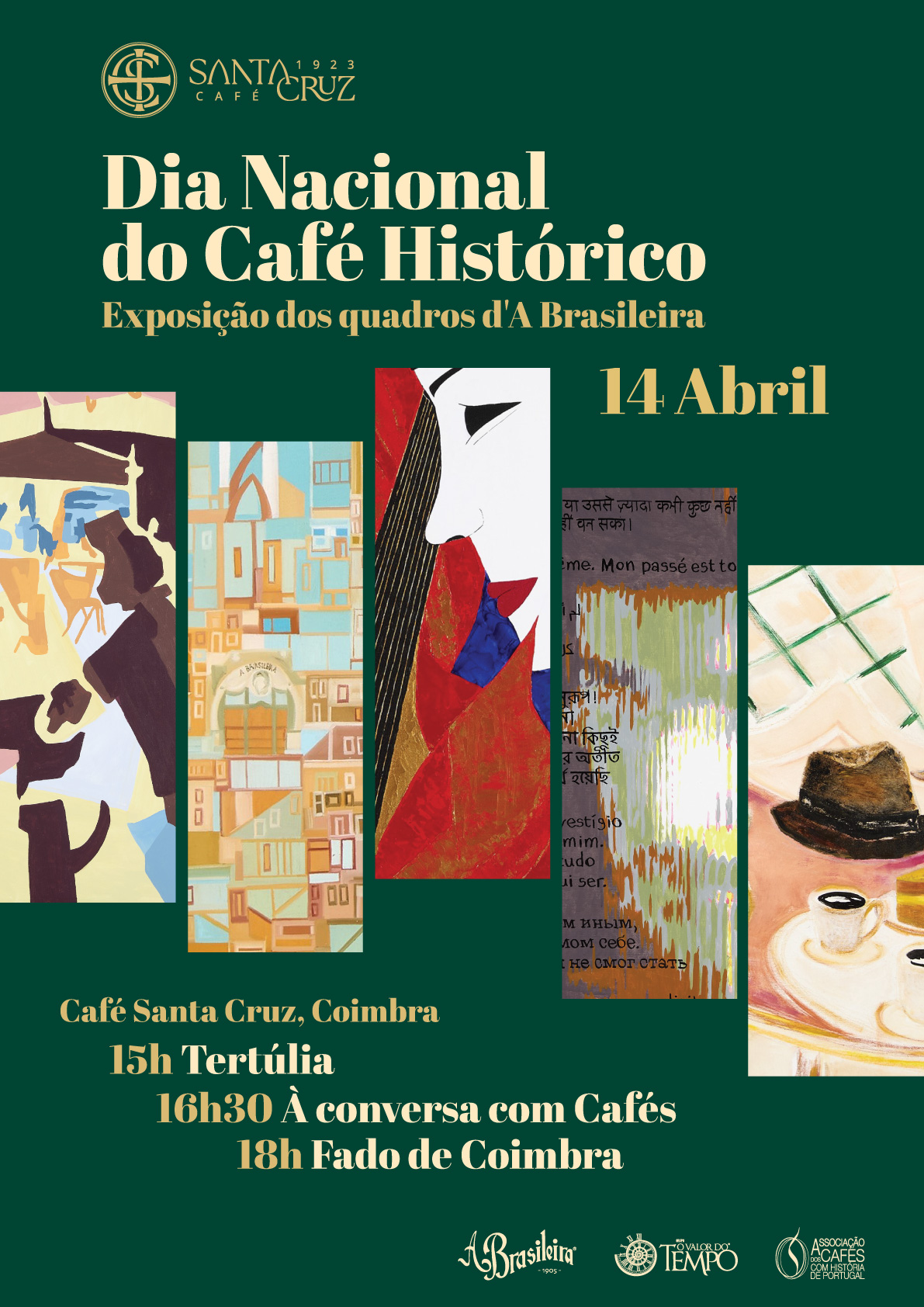
The works are the result of the “A Brasileira do Chiado Painting Prize,” launched in 2024 as part of the centenary celebrations of the first modernist exhibition held in that café in 1925. The 10 winning artists have had their works exhibited at A Brasileira since January 2025, temporarily replacing the set installed in 1971, which is currently undergoing restoration and will return to the walls of A Brasileira.
The exhibition in Coimbra will take place in the former main altar of the Church of São João de Santa Cruz, now the café’s cultural space, and will be presented in two stages: on April 14th, National Historic Café Day, and on May 8th, the date marking the 103rd anniversary of Café Santa Cruz.
The opening on April 14th will feature a cultural program: a round table discussion with some of the winning artists and another with representatives from Portuguese Historic Cafés, including A Brasileira do Chiado, Café Santa Cruz, Café Majestic, and Pastelaria Gomes, all historic cafés. A catalog dedicated to the project will also be presented, bringing together texts, images, and contributions from various stakeholders. With this initiative, Café Santa Cruz invites the public to participate in an event that celebrates and showcases the cultural heritage of historic cafés in Portugal.
More than just an exhibition, this initiative reinforces the role of historic cafés as spaces of memory, encounter, and cultural identity, where different generations continue to meet. Currently, 23 Portuguese historic cafés are part of the Historic Cafés Route, a European cultural route certified by the Council of Europe, which includes both Café Santa Cruz and A Brasileira do Chiado.
Over the years, historic cafes such as A Brasileira do Chiado (1905) in Lisbon, Café de Santa Cruz (1923) in Coimbra, Café Vianna (1858) in Braga, Majestic (1921) in Porto, Café Bar S. Gonçalo (1937) in Amarante, Peter Café Sport (1918) in the Azores, or Pastelaria Gomes (1925) in Vila Real, have weathered eras and withstood the many turbulent periods of our history, such as the establishment of the Republic, the two World Wars, the Estado Novo regime, the 1974 revolution, the subsequent economic and social upheavals, and more recently the pandemic caused by Covid-19 and the war in Ukraine.
Many of them were frequented by great figures of the arts: from Fernando Pessoa to Almada Negreiros at A Brasileira, Bissaya Barreto at Café de Santa Cruz, Teixeira de Pascoaes at Café S. Gonçalo, Eça de Queiroz and Camilo Castelo Branco at Café Vianna, or J.K. Rowling at the Majestic. In all of them, time passes by itself, as if it didn’t, preserving in the walls, chandeliers, and furniture the stories of other lives.